Getting Away With Murder, by Robert James Bidinotto, July 1988 reprint from Reader's Digest.
In Massachusetts, convicted killers roamed the streets on weekend passes. Then a crusading newspaper and outraged citizens took action. This is a copied personal copy; journalist' styling differed.

On the night of October 26, 1974, Joey Fournier, age 17, was working alone at a Marston Street Mobil service station in Lawrence, Mass. Three men drove up and entered the gas station, demanding money. Joey gave them $276.37 and pleaded for his life.
Minutes later, Michael Bryon, one of Joey’s friends, stopped by. The office floor was covered with blood. Horrified, Michael found Joey’s body stuffed in a trash barrel, his feet jammed up near his chin. He had been stabbed 19 times.
Three men- Alvin Wideman, Roosevelt Picket, and William R. Horton, Jr. (WILLIE HORTON)-were soon apprehended. All confessed to the robbery, but not to Joey’s murder. Prosecutors were convinced that the actual killer was Horton. He had previously served three years in South Carolina for assault with intent to murder.
In May 1975, the trio was convicted of robbery and first-degree murder. In many states, they could forfeit their lives. But a few weeks earlier, Gov. Michael Dukakis had vetoed a death penalty bill.
Still, a first-degree murder conviction was supposed to mean a mandatory sentence of life in prison, with no possibility of parole. The Fournier family, devastated by their loss, took comfort in the prosecutor’s assurance that Joey’s killers would never again walk the streets.
Under a little-known state law, however, such first-degree killers were eligible for unguarded, 48-hour furloughs from prison. On June 6, 1986 William Horton was released from the Northeast Correctional Center in Concord. He never came back.
About 7:30 P.M. on April 3, 1987, Clifford Barnes, 28, heard footsteps in his house in Oxon Hill, Md. He called out thinking Angela Miller, his fiancée, had returned home early from a wedding party. Instead, a man suddenly loomed before him, pointing a gun. It was William Horton.
For the next seven hours, a laughing Horton punched, pistol-whipped, and kicked him. Horton also cut him 22 times across his midsection.
Later that night, Angela returned. Bound and gagged, Cliff listened in helpless horror to Angi’s screams as Horton savagely attacked her. For four hours, she was assaulted, tied up, and twice raped.
Finally, Clif broke free and staggered to a neighbor’s home for help. Angi cut herself loose and escaped through a window. Now panicked, Horton stole Cliff’s car and fled. After a high-speed police chase, he was wounded in a shoot-out and captured.
In Lawrence, Susan Forrest, a young reporter for the Eagle-Tribune, was covering Horton’s rampage and recapture. But one chilling detail puzzled her, “The question everyone wants answered.” she wrote “is how a cold-blooded murderer ever got out in the first place.”
Forrest’s editor Dan Warner encouraged her to find out. But she ran into a bureaucratic stone wall. Michael Fair, commissioner of the Massachusetts Department of Corrections, at first refused to talk to her. Then he cited the state’s 1972 Criminal Offender Record Information Act, which strictly limits public access to court and prison records of convicted killers, and criminals. The right to privacy that made their crimes virtually a state secret.
Warner and Forrest were outraged, They could not find out why Horton had been released or why Horton had been released or how many other Hortons were walking the streets. Forrest appealed to the governor for an interview but was rebuffed.
Still, Susan Forrest’s hard-hitting front-page stories provoked public wrath. And two state representatives-former police officer Larry Giordano and Joseph Hermann-introduced a bill to ban furloughs for first-degree murderers.
At the public hearing on Giordano’s bill on May 27, 1987 members of Joey Fournier’s family listened as his sister Donna Fournier Cuomo, and his father, Ronald, begged lawmakers to end the furloughs. Another witness George Chaffee of Derry N.H. told a harrowing tale. His 44-year-old mother had been brutally beaten and murdered by a confessed Massachusetts rapist John Zukoski. Even after being convicted for second-degree murder, Zukoski became eligible for furloughs; and in September 1986 he was paroled, A few months later Zukoski was arrested yet again for beating and raping a woman. *“How many times,” Chaffee demanded before he is locked up for good.”
The victims’ families made an impact on everyone present. The biggest shock, however, came from the testimony of associate Correction Commissioner Nennis Humphrey.
A sentence of “life without parole,” Humphrey revealed, was meaningless. It was assumed that eventually everyone-even first-degree murderers like Horton would have their sentences commuted. and “get out/” After only 10 years, a lifer was routinely transferred to a minimum-security facility, which has no walls. There he becomes eligible for furloughs. Horton has been on his 10th-weekend pass when he disappeared.
The Massachusetts inmate furlough program was enacted in 1972 under Gov. Francis W. Sargent, and a killer soon escaped. This stirred up a legal controversy, but in 1976 Governor Dukakis pocket vetoed a bill to ban furloughs for first-degree murderers. It would he said, “cut the heart out of efforts at inmate rehabilitation/”
The furlough program, in essence, released killers on an “honor system” to see if they would stay out of trouble. This trial-and-error approach helped the governor decide when to commute, or reduce, a first-degree murder sentence, thus making a lifer eligible for parole. On average prisoners’ sentences commuted from life without parole spend 19 yrs in prison. Governor Dukakis, in fact, had already commuted 28 first-degree murderers by March 1987.
When Donna Fournier Cuomo learned that Horton had been repeatedly granting furloughs, all the nightmares of her brother’s death returned. At the May 27 hearing, she met other concerned women” Maureen Donovan, Joan Bamford, Joanne Pekarski, and Gertrude Lavigne. They had learned that the weekend Horton fled, he’d been spotted only two blocks from the Donovans’ home. “It could have been my family he went after,” she said.
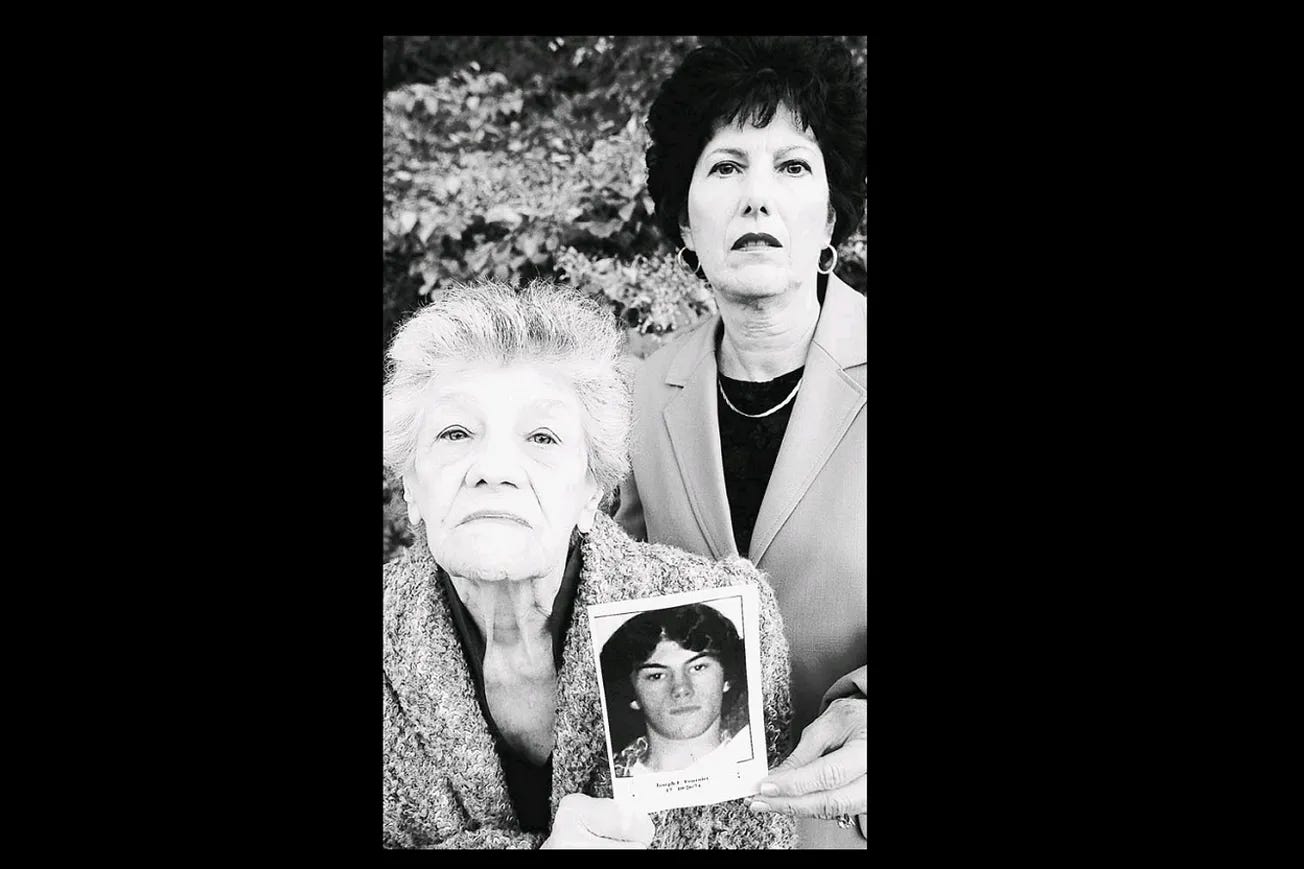
NEVER FORGET: Hilda Marie Fournier, left, and her daughter, former state Rep. Donna Fournier Cuomo, holds a picture of son, Joseph Fournier, who was killed the night of Oct. 26, 1974, at Lawrence gas station by Willie Horton.
The women circulated a petition to support Representative Giordano’s furlough ban bill. But the bill was stalled in committee by legislative allies of Governor Dukakis.
In the face of growing public opposition to the Dukakis, the administration made some revisions in the furlough guidelines (eligibility became 121/2 years in prison rather than the then 10) but defended the program relentlessly. At a news conference, bureaucrats trotted out figures showing that relatively few killers on furlough had escaped. Human Services Secretary Philip Johnston told astonished reporters. “Don’t forget Mr. Horton had 9 previous successful furloughs.” (THEY ASSUMED.)
To Commissioner Fair, furloughs were a prison “management tool.” Unless a lifer has hope of parole, he argued, “we would have a very dangerous population in an already dangerous system.” But, critics wondered, if armed guards can’t control “very dangerous” killers inside locked cells, ** how are unarmed citizens supposed to deal with them?
When Dukakis visited the Andover, Mass. police station one day, furlough opponents Maureen Donovan, Joanne Perkraski, and Mary Gravel got to meet with him. Gravel told the governor about her own daughter’s unsolved murder. "What if Claire’s killer is caught and convicted, then furloughed?” she asked,” What do you think my family would do if they were walking down the street and saw this person?”
“I’d probably feel the same way you do,” Dukakis responded. “But unfortunately, it’s not going to change my mind.”
The governor began recounting a recent discussion with inmates’ families about their grievances, but Maureen Donovan angrily interrupted. “You’ll meet with inmates’ families, but you keep avoiding us.”
The meeting quickly deteriorated. Dukakis explained that he hadn’t asked for the power of communication. Gravel replied, “There’s no law that says you have to use it”
“If you don’t like the system, you can change it,” the governor said. “Thank you very much,” Donavan answered, “That’s exactly what we’ll do.”
The encounter with Dukakis convinced the women that their best option was to put a referendum about the furloughs on the November 1988 ballot. “Within weeks, they formed CAUS-CITIZENS AGAINST UNSAFE SOCIETY.
Susan Forrest had still been unable to get Horton’s records. Red up, Sam Warner invited every newspaper editor in the state to a meeting in May 1987. There, he and Forrest denounced the prisoner privacy statute and asked for support to open Horton’s files. The result was a flood of articles and indignant editorials. Finally, under pressure, the state released Horton’s records. These confirmed that while in prison, he had a record of 11 disciplinary infractions, three drug-related. Yet prison officials eventually gave Horton “excellent” evaluations and said, “he projects quite a sense of responsibility.”
In the months following the hearing, there were other revelations. 1)Legislators learned that Horton had also been turned loose daily, with little supervision, on a daily work-release program. His job to help mental patients. 2) Of over 80 Massachusetts convicts listed as escaped and still at large, only four had actually ‘‘escaped.” The rest simply walked away from furloughs, prerelease centers, and other minimum-security programs. These convicts included murderers, rapists, armed robbers, and drug dealers. 3) Commissioner Fair personally approved first-degree-lifer Armand Therrien’s transfer from a medium-security prison to a minimum-security one, which made him eligible for a work release program. Therrien, a two-time murderer, walked off and vanished in December 1987.
None of the women of CAUS had ever been involved in grass-roots politics, and they faced an enormous job of gathering 50,525 certified voter signatures by early December 1987, the deadline for the 1988 ballot. Before long, they were regular fixtures on talk shows, and other volunteers came forward.
Many of the CAUS members, like the Fourniers and Gravels were families of murdered children. George Harris, a retired police officer, was an early recruit. His son George Jr a state trooper, was shot and killed while on duty in 1983. Marion and Jon Spinney’s daughter, Karen was stabbed to death in 1975 by an armed robber who was on furlough. Paula Marie, in 1986 was also given a meaningless sentence of “life without parole,”
The signature drive became their crusade. Working 15-hour days, the core group of 20 people canvassed the state, haunting shopping malls, bingo halls, and churches. Paula Danforth, eight months pregnant, helped corral a thousand signatures in one day.
A Massachusetts House committee held further hearings. Families of victims told their stories, including Vivianne Ruggiero, whose 27-year-old husband John, a police officer had been shot in the head five times without provocation, John left his widow with two small children, Meanwhile, Vivianne testified John’s convicted killer, Daniel Ferreira, sentenced to life without parole, had married while on one of his 33 furloughs. “Isn’t he lucky that he can go on with his life?” Vivianne said bitterly. “I wish I could have a furlough-one weekend, or one hour when my husband’s death is not on my mind.”
Cliff and Angi Barnes Horton’s victims also testified. “I’m tired of hearing about the rights of prisoners,” Angi said, “As far as I’m concerned, they gave up those rights when they took another person’s life.” Cliff was asked about the success rate of the furlough program. “So we’re expendable,” he retorted, “Is that what they are saying?”
After the hearings, CAUS members worked feverishly to collect and deliver signed petitions to city halls across the state. Late at night on December 1, 1987, nine bone-weary volunteers crowded into Joan Bramford’s living room to tally the results. They had 52,407 signatures, There were screams, tears, and hugs all around.
In the waning days of 1987, CAUS members were glad they had taken matters out of politicians’ hands, The state’s House [assed Giordannos’s bill overwhelmingly. But in the Senate, Royal Bolling Sr. used parliamentary stalling tactics to kill it as the legislative session ended.
A month later, Bolling received a standing ovation for his efforts from 400 inmates at Norfolk prison. “I’m always glad to see some of my old friends,” “I hope I will continue to deserve your goodwill.”
The occasion for this strange episode was 'Legislative Awareness Day,” an annual event that reminds Massachusetts inmates they are allowed to Vote. An inmate leader urged fellow convicts to register and vote against the referendum banning furloughs. a deputy secretary of state Richard Shilbey, brought in hundreds of absentee ballot applications.
Although the CAUS referendum was virtually assured of voter approval in November, Representative Giordano reintroduced his furlough ban bill to halt the program even sooner. And, as spring arrived, Dukakis came under mounting pressure to end the furlough program himself before it hurt his Presidential campaign.
On March 22, 1988, at a packed news conference, the governor promised not to veto Giordano's bill. Asked if he was personally in favor of furloughs, Dukakis answered, "That is irrelevant. The fact of the matter is that the people of the Commonwealth and the legislature aren't." He added he still wanted some alternative program to help him commute the sentences of first-degree murderers. On April 28, after the legislature passed the furlough ban by a wide margin, the governor signed it into law. (In preparing this article, Reader's Digest requested an interview with Governor Dukakis, but he declined.)
For Maureen Donovan, CAUS's feisty co-founder, the work to reform the system has just begun. With Dukakis seeking an alternative to the furlough program, CAUS has announced its next goal will be to restrict the governor's power to commute life sentences.
For the Lawrence Eagle-Tribune, an effort to uncover hidden facts became a crusade by Susan Forrest, Barbara Walsh, and other determined reporters. The furlough system was finally exposed to public scrutiny. On March 31, 1988, the Eagle-Tribune, received journalism's highest honor: The Pulitzer Prize.
For Donna Fournier Cuomo, the issue remains hauntingly, harshly personal. On the 13th anniversary of her brother's murder, she visited the now-deserted gas station in Lawrence. She cried softly as she stared at the empty windows, symbols of the terrible waste. Joey, she thought, would have been 30 yrs old.
"Someone asked, "Are you doing this for your brother?" "Donna once testified. "I guess I am,... because if I didn't, he'd died for nothing. And then you couldn't live with yourself because justice would not have been served[GH1] "
Bonus: EVERYTHING YOU THINK YOU KNOW ABOUT WILLIE HORTON IS BULL. “One of my objectives, quite frankly, is to lock Willie Horton up in jail.” —Joe Biden, Senate Judiciary Committee Chair, bragging Democrats were tougher than Republicans on criminals, 1990. The nation’s 2022 top-tier fear is crime. Three quarters of Americans say violent crime is a major problem, and getting worse. Democrats’ cashless bail laws, attacks on police, and other liberal soft-on-crime policies have unleashed unrestrained criminality across the country, particularly in Democrat-run cities, where dangerous criminals are no longer locked up in jail. At all. “Arrested-and-released” is now the most common phrase in every crime article.
This, in turn, led to the election of Giuliani and his Broken Windows Theory, which decreased crime by nearly half. Cuomo continued this pattern when he was Mayor with even more success.
Yes, the same Cuomo, who is under investigation for COVID Nursing Home Deaths today. Comer Refers Andrew Cuomo to DOJ for Criminal Charges for Lying About Nursing Home Deaths.

TRUMP IS PRESIDENT. The change is now called TRUMP DERANGEMENT SYNDROME. Criminals added Illegal Aliens Biden let flow unchecked, and their crimes.
Child rapist from Brazil living at Cape Cod daycare.
Bet he was illegal too. Mass is two blue of a state to mention a fact like whether he was or wasn’t an illegal alien.
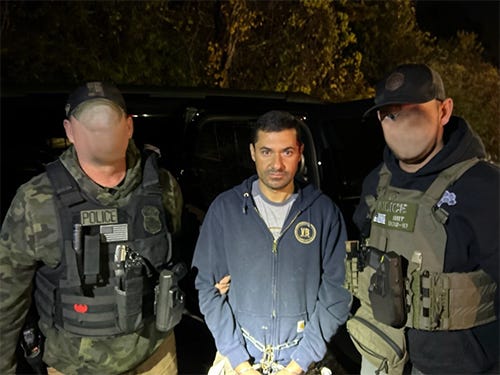
A licensed home daycare on Cape Cod has closed its doors following the arrest of a convicted child rapist who had been staying there. According to U.S. Immigration and Customs Enforcement (ICE), Tiago Lucas, a Brazilian national, fled to Massachusetts to evade a nine-year prison sentence in his home state of Minas Gerais for the rape of a 13-year-old girl. ICE agents apprehended him in Bourne last October. This gap in the screening process means that even if Nunes had disclosed Tiago Lucas’s presence, his conviction in Brazil would not have been flagged by the state’s current vetting procedures.
Child-rapist migrant who fled Brazil found living at Massachusetts daycare center: ‘Terrifying’. Child rapist Andre Tiago Lucas, who is reportedly the father of the home daycare owner’s two kids, escaped Brazil for the States after he was sentenced in 2016 to nine years and four months in prison, according to Immigration and Customs Enforcement. Brave Question answer. Did Andre Tiago Lucas Enter USA Illegally?
Regarding Andre Tiago Lucas, he fled to the United States before beginning his sentence for raping a 13-year-old girl in Brazil. He eventually settled in Massachusetts, where he was arrested by ERO officers in Bourne last October.2 The context does not explicitly state whether he entered the U.S. illegally, but given his status as a fugitive and his criminal history, it is likely that his entry was not legal.
Born in Lawrence, I enjoyed my few years there in the 60s. I went back to visit several times over the years, but in the mid 90s, I wouldn't have dared get out of my car.
"A sentence of “life without parole,” Humphrey revealed, was meaningless. It was assumed that eventually everyone-even first-degree murderers like Horton would have their sentences commuted. and “get out/” After only 10 years, a lifer was routinely transferred to a minimum-security facility, which has no walls. There he becomes eligible for furloughs. Horton has been on his 10th-weekend pass when he disappeared. "